Subsurface Flow and Transport Modelling for Groundwater Risk Analysis
Finite element simulation of groundwater flow and contaminant transport in layered aquifer systems to evaluate vulnerability under pumping stress.
Hydrogeology • Subsurface Flow • Environmental Risk Modelling
Project Context
Surface monitoring captures land transformation but rarely resolves how contaminants propagate below ground. Groundwater systems transport pollutants through complex geological structures where hydraulic gradients, permeability contrasts, and pumping stresses control migration pathways.
This project developed a numerical model to investigate how a surface contaminant source migrates through a layered aquifer system and how groundwater extraction alters exposure risk.
The central question addressed was: How does surface disturbance translate into groundwater vulnerability?
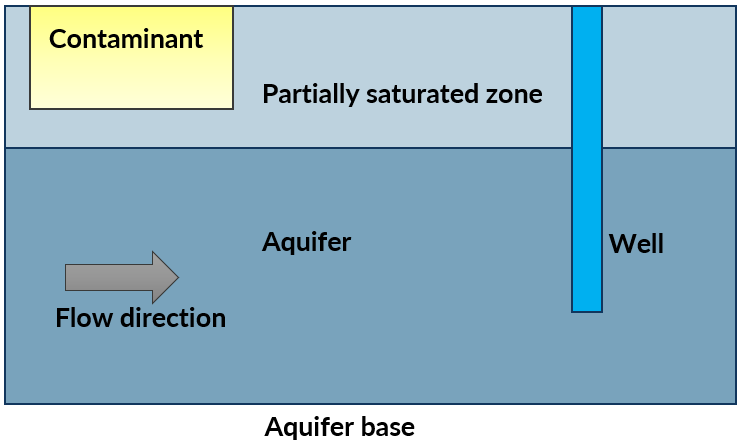
Conceptual representation of the hydrogeologic system showing a surface contaminant source, layered aquifer structure, and a pumping well that generates hydraulic gradients capable of drawing contaminants toward the extraction zone.
Project Quick Facts
- Model Platform
COMSOL Multiphysics 6.2 - Model Type
Finite Element Groundwater Simulation - Domain
Layered Aquifer Cross Section - Physics
Darcy Flow + Advection–Dispersion - Processes
Groundwater Flow, Solute Transport - Outputs
Velocity Fields, Plume Evolution, Breakthrough Curves
Governing Physical Processes
Reactive transport within the soil profile is governed by coupled groundwater flow, solute transport, and chemical transformation processes. Infiltration generates hydraulic gradients that drive water movement through the soil matrix, while dissolved contaminants are redistributed through advection, dispersion, and degradation reactions.
Swipe → to view full table
| Process | Governing Equation | Interpretation |
|---|---|---|
| Groundwater Flow |
q = −K ∇h
|
Darcy’s Law governs groundwater flow through porous media. Hydraulic gradients generated by infiltration drive water movement downward through the soil profile. |
| Solute Transport |
∂C/∂t + v·∇C = ∇·(D∇C)
|
The advection–dispersion equation describes migration of dissolved contaminants through the soil matrix. Advective groundwater flow transports solutes while dispersion spreads the plume through molecular diffusion and mechanical mixing. |
Where: q = Darcy flux; K = hydraulic conductivity; h = hydraulic head; C = contaminant concentration; D = hydrodynamic dispersion coefficient; v = pore water velocity; k = first-order reaction rate constant.
Conceptual Workflow
Numerical Model Framework
The simulation domain represents a layered aquifer composed of clay, sand, and gravel units. Contrasting permeability between these layers controls flow velocity and contaminant migration pathways.
- Clay layers act as low permeability barriers
- Sand units provide moderate flow pathways
- Gravel zones accelerate groundwater transport
- A pumping well generates hydraulic gradients
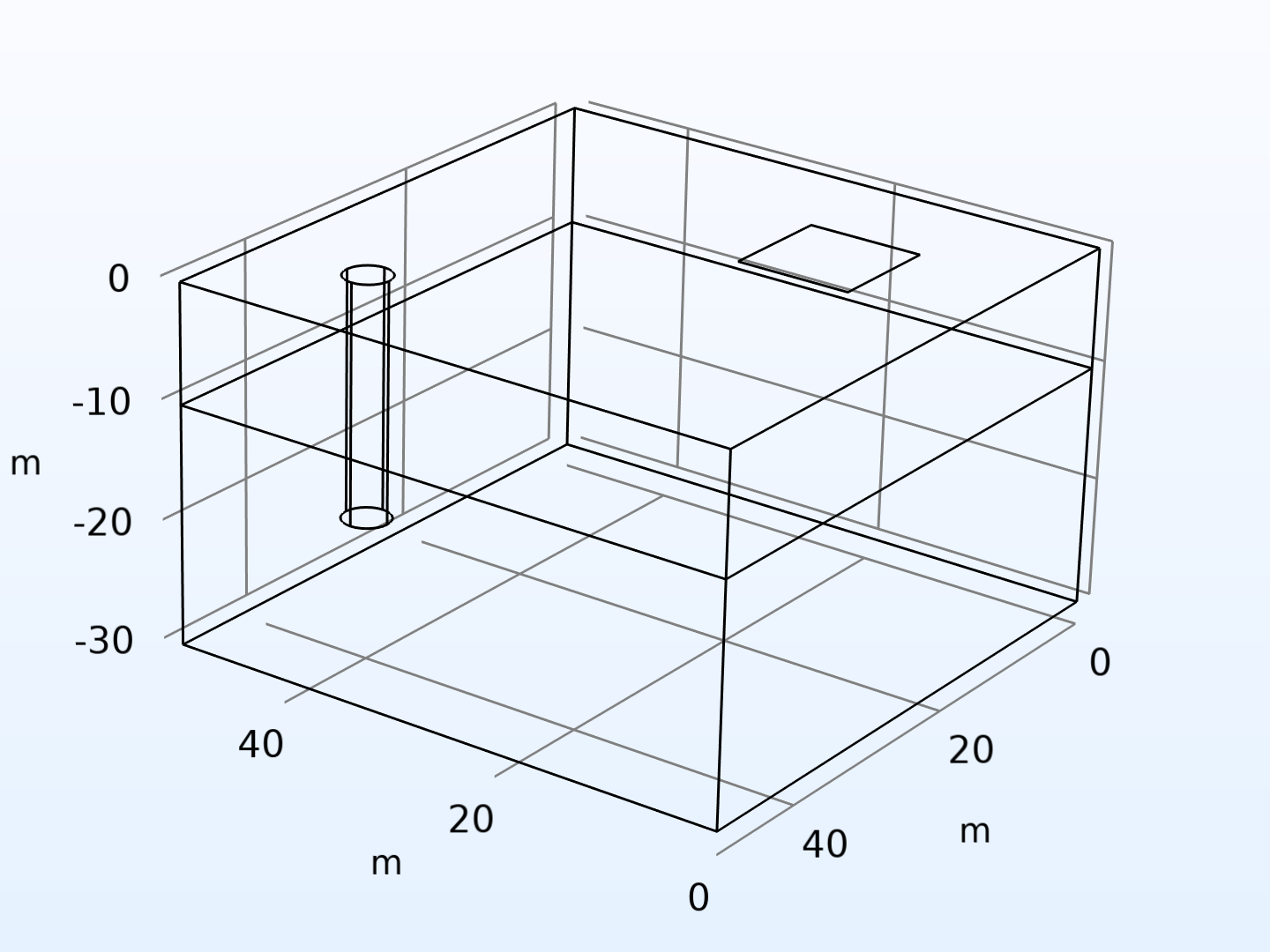
Finite element representation of the layered aquifer system used in the groundwater simulation.
Contrasting permeability between clay, sand, and gravel units controls groundwater velocity and contaminant migration pathways.
Groundwater Flow Behaviour
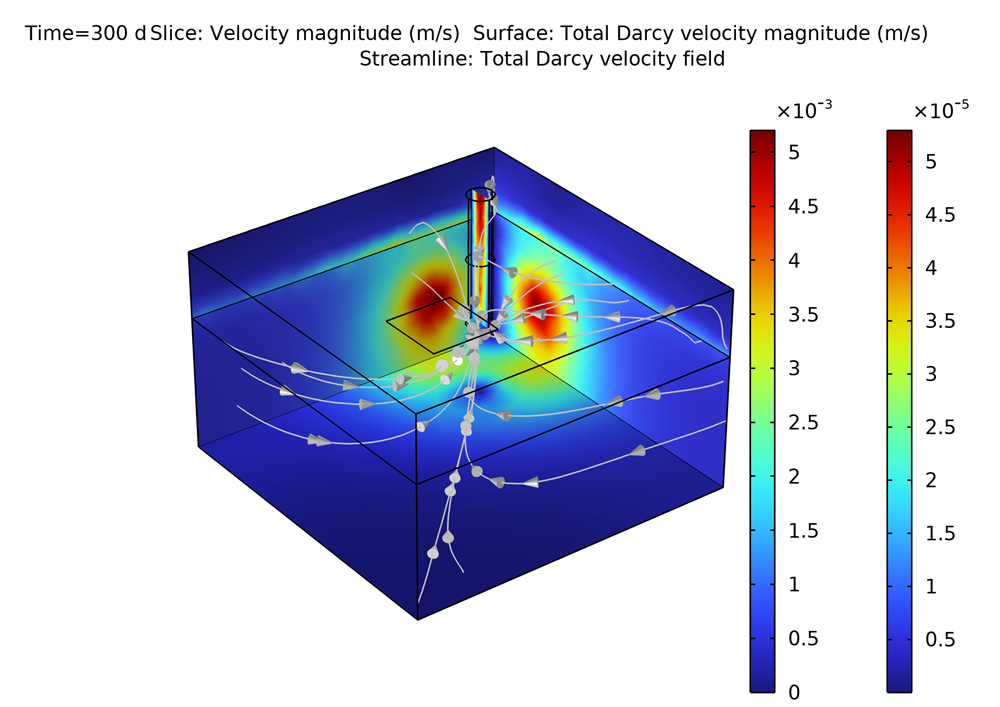
Simulated groundwater velocity streamlines showing the hydraulic capture zone generated by the pumping well.
Flow vectors converge toward the extraction point, demonstrating how groundwater abstraction redirects regional flow paths.
Hydraulic Stress and Drawdown
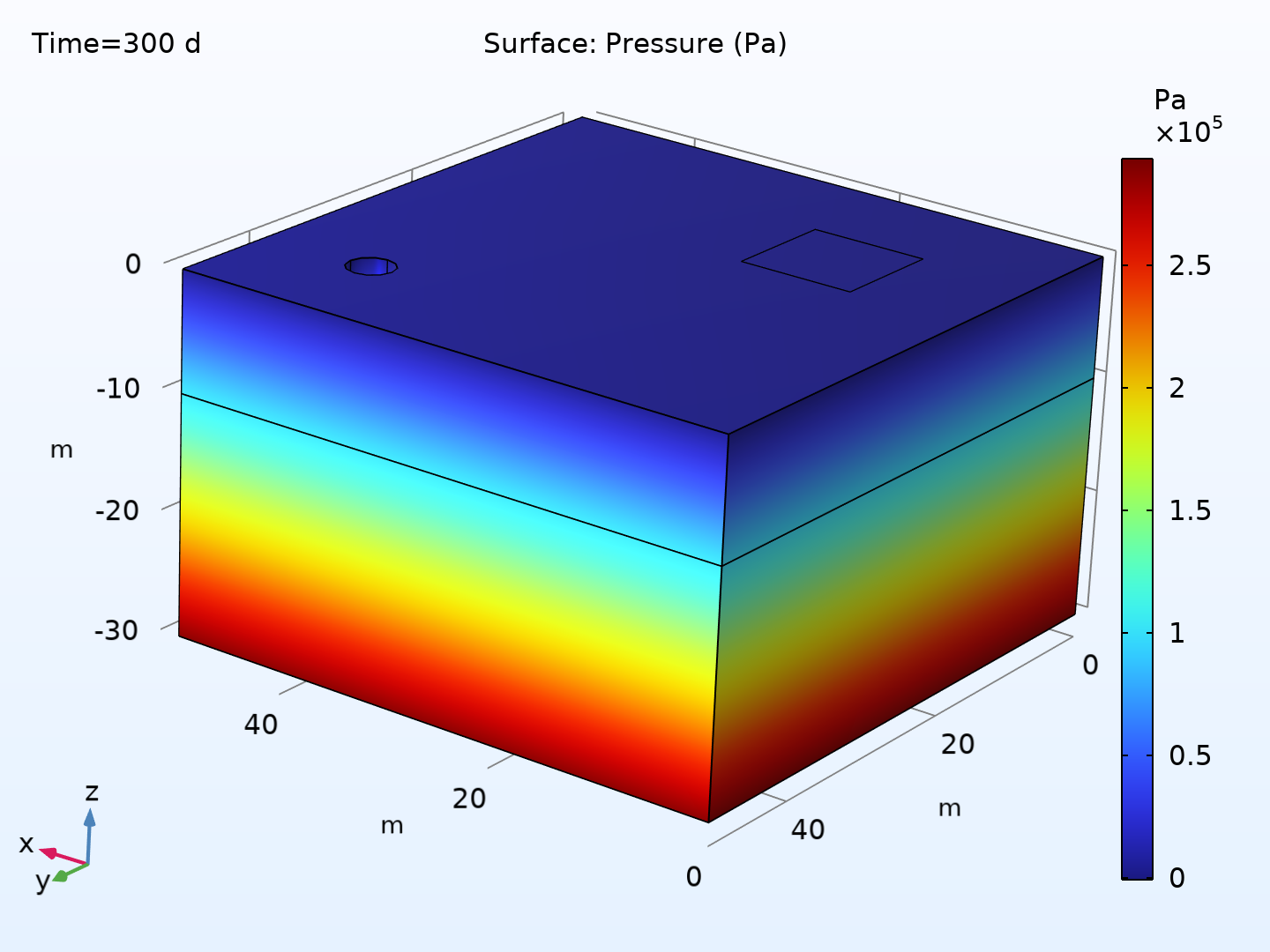
Pressure head distribution illustrating the drawdown cone generated by groundwater extraction.
Hydraulic gradients intensify near the well, increasing flow velocities and expanding the potential capture region.
Contaminant Migration
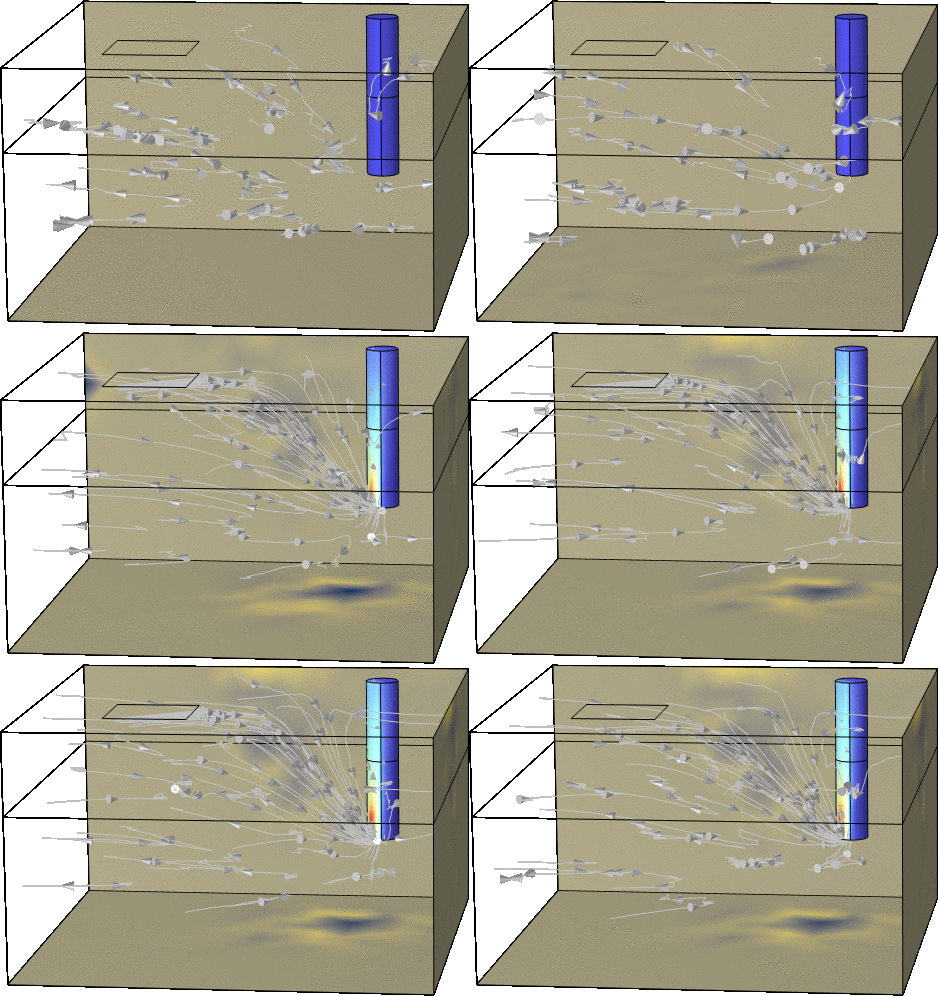
Contaminant Migration
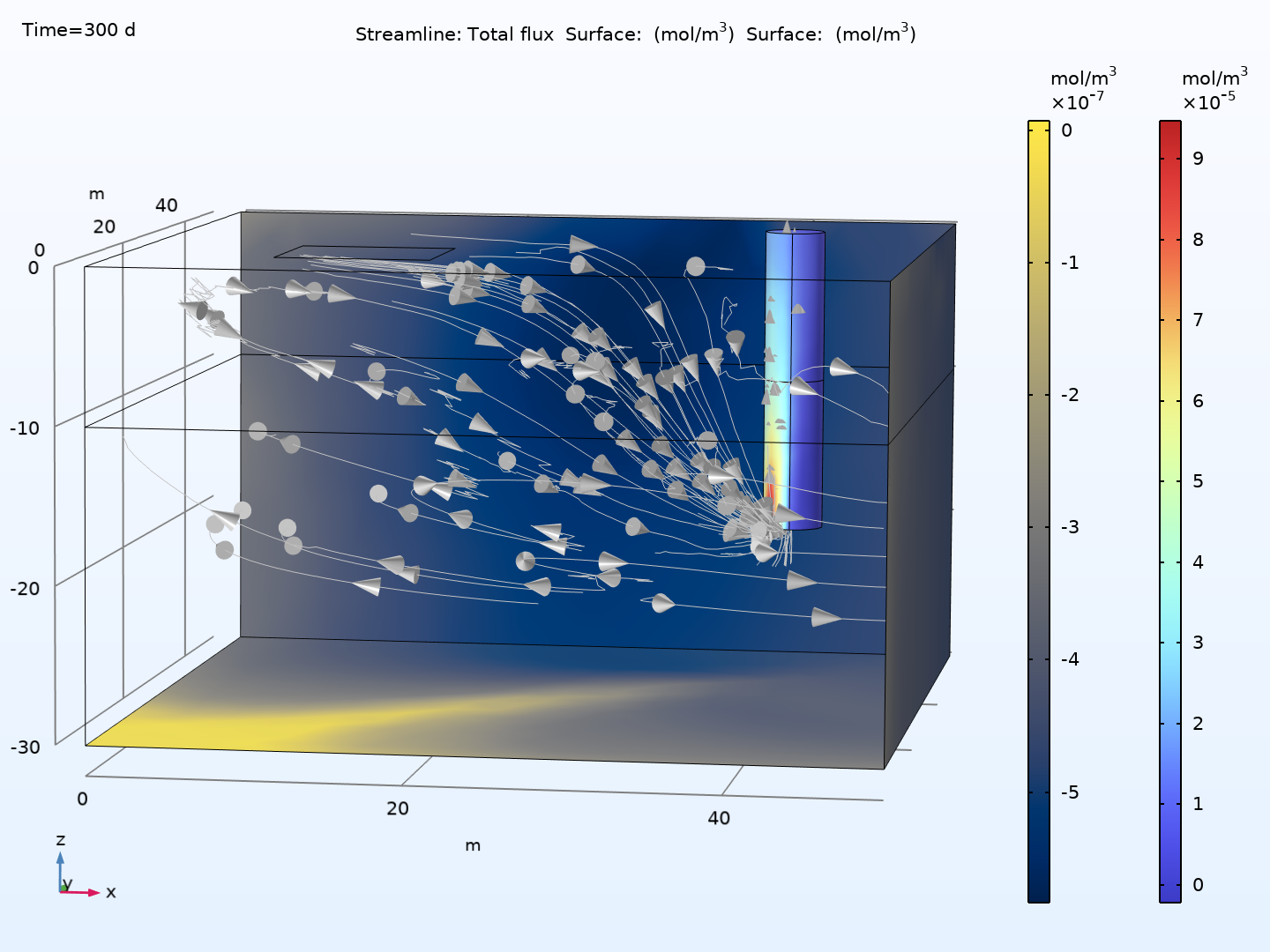
Simulated contaminant plume transported through the layered aquifer system under advective groundwater flow.
Preferential migration occurs through higher-permeability layers, directing the plume toward the pumping well.
Breakthrough Behaviour
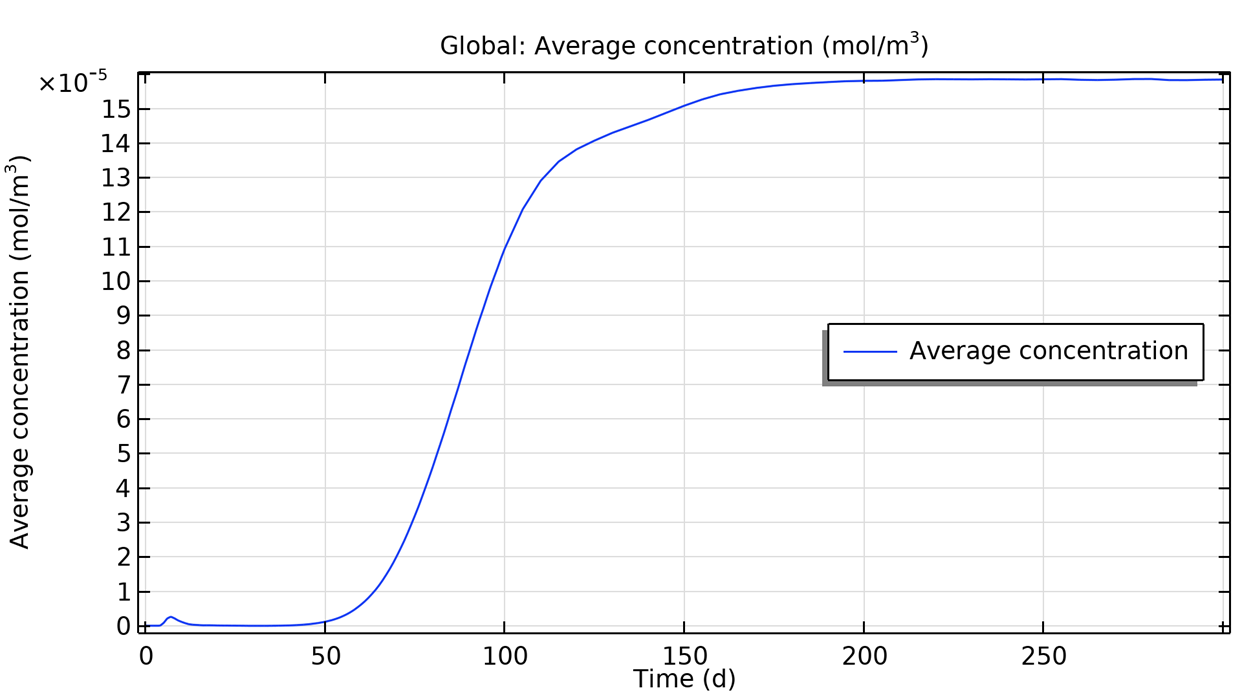
Breakthrough curve showing contaminant concentration at the pumping well over time.
The delayed peak concentration reflects travel time through the aquifer and dispersion processes during plume migration.
Model Assumptions and Limitations
- Two-dimensional conceptual aquifer geometry
- Homogeneous hydraulic properties within layers
- No chemical reactions or sorption processes included
- Constant pumping rate and boundary conditions
Note: This model builds on structured COMSOL training workflows and extends them to explore environmental transport behaviour and interpretation.