Reactive Transport Modelling of Pesticide Fate in Variably Saturated Soil
Coupled kinetic–hydraulic simulation of pesticide degradation and transport used to evaluate groundwater contamination risk under infiltration-driven conditions.
Reactive Transport Modelling • Contaminant Hydrogeology • Groundwater Risk Assessment
Problem Framing
Surface-applied pesticides initiate a coupled hydraulic and chemical response within the subsurface. As infiltration occurs, dissolved contaminants migrate through soil while simultaneously undergoing degradation reactions that transform the parent compound into secondary species.
These transformation pathways are environmentally important because degradation does not always reduce groundwater risk. Intermediate products may be both mobile and toxic, allowing contamination to propagate beyond the zone expected from the parent compound alone.
This project developed a reactive transport modelling framework in COMSOL Multiphysics to evaluate how coupled chemical reactions and unsaturated flow processes influence the spatial and temporal evolution of pesticide contamination beneath an infiltration source.
Project Quick Facts
- Model Platform
COMSOL Multiphysics 6.2 - Model Type
Reactive Simulation - Domain
Axisymmetric Soil Column - Simulation
10 Days - Species Simulated
Parent + 2 Degradation Products - Physical Processes
Unsaturated Flow, Solute Transport, Chemical Reactions - Application
Pesticide Fate and Groundwater Risk
Reactive Plume Evolution
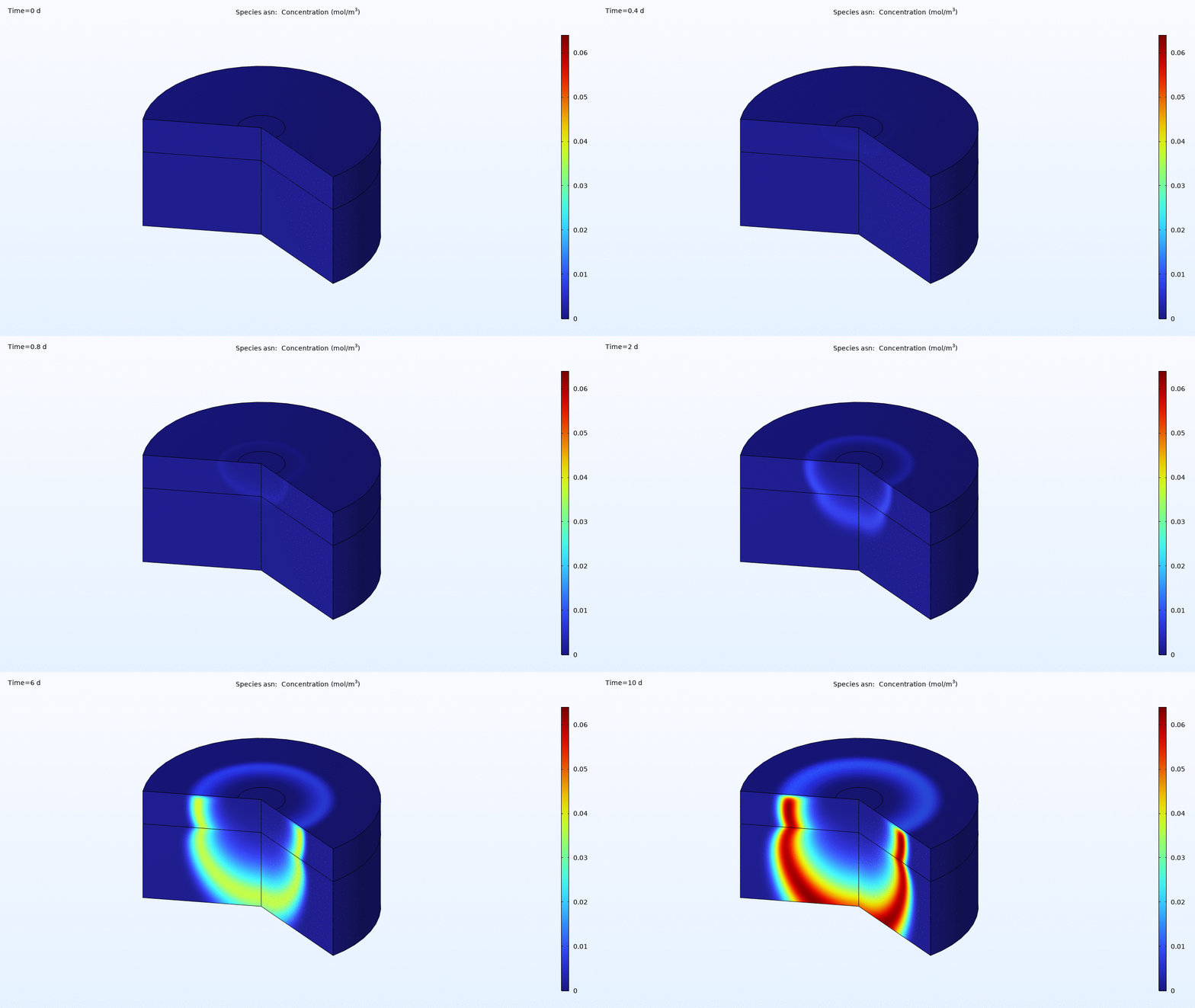
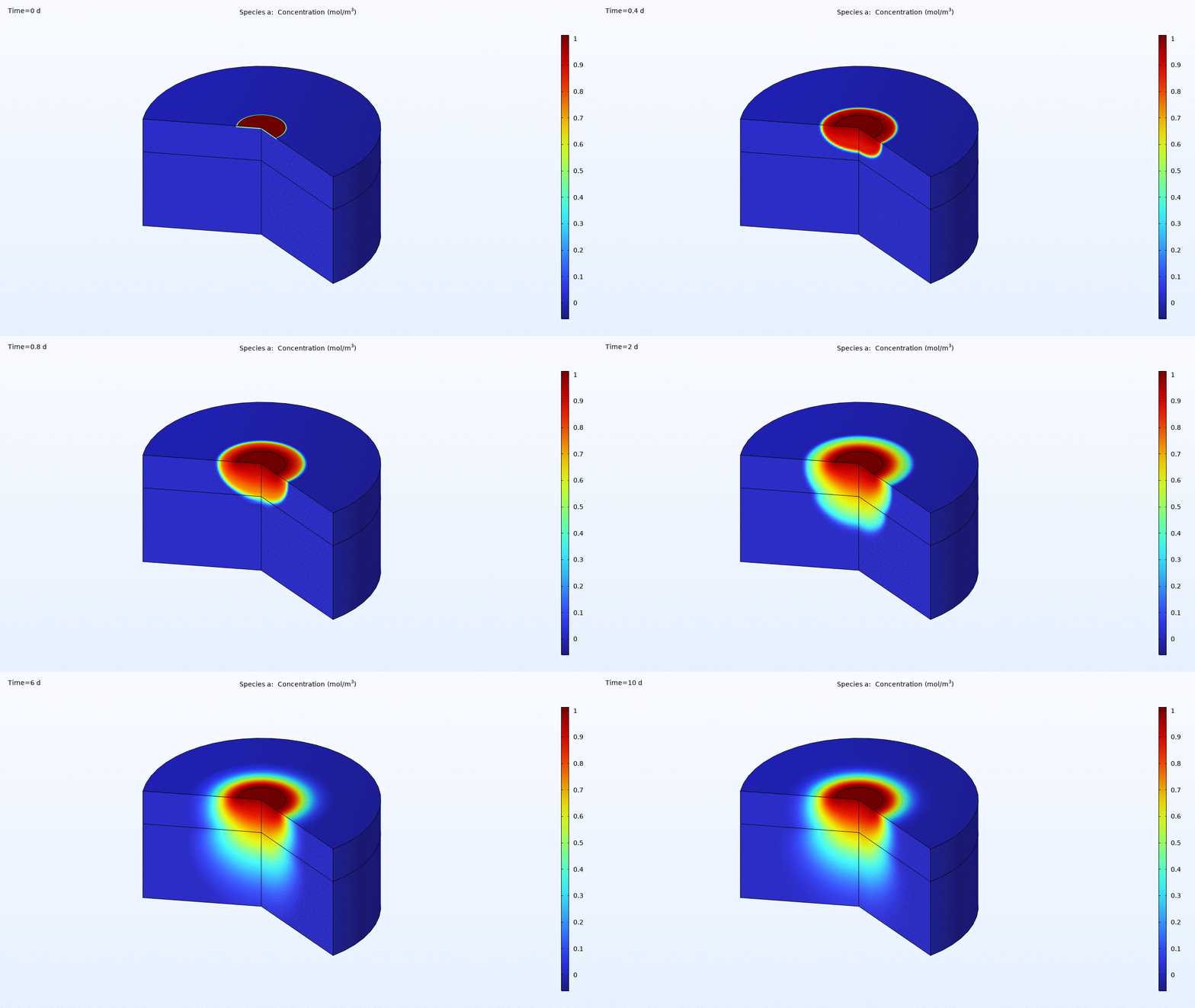
Figure 1. Time-evolving contaminant plume produced by the reactive transport simulation. The animation shows infiltration-driven migration of pesticide compounds through variably saturated soil while chemical reactions transform the parent compound into secondary products. Although concentrations decline near the surface due to degradation, reactive transformation and advective transport redistribute contaminants deeper within the soil profile, demonstrating that surface decline does not necessarily correspond to reduced groundwater risk.
Reaction Kinetics Model
Before coupling chemistry with subsurface flow, degradation behaviour was analysed using a well-mixed reaction kinetics model. This simplified system isolates chemical transformation pathways without spatial transport effects.
The model represents sequential oxidation of the pesticide compound into two principal degradation products: aldicarb sulfoxide and aldicarb sulfone. These reactions determine how toxicity and persistence evolve through time.
The resulting rate constants were incorporated into the transport simulation to ensure that plume evolution reflects chemically realistic degradation behaviour.
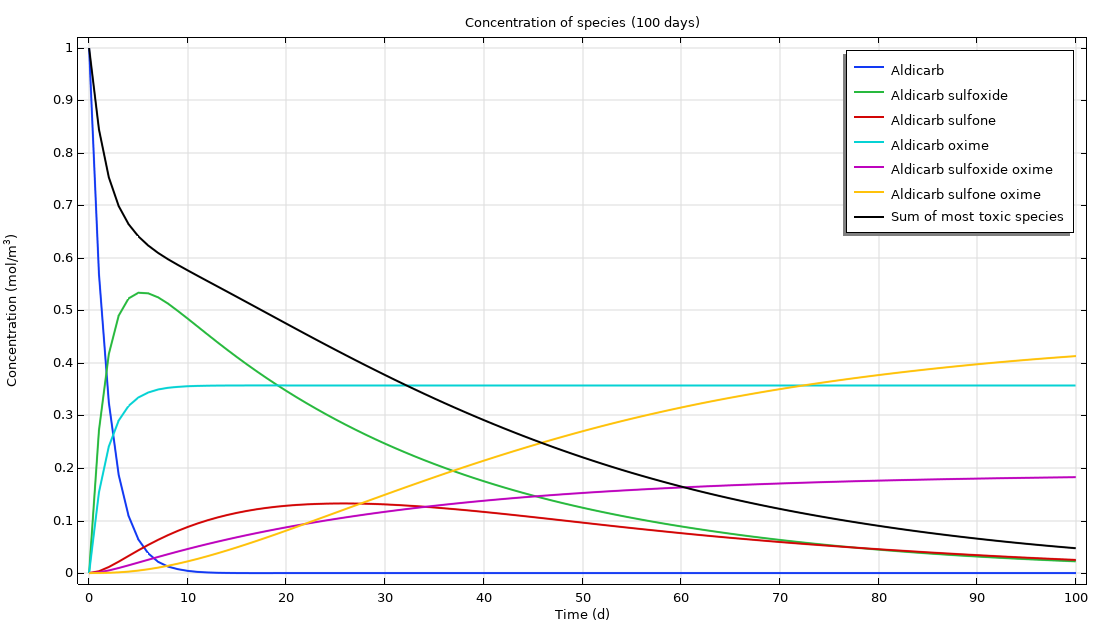
Figure 2. Reaction kinetics simulation showing sequential transformation of the parent pesticide compound into sulfoxide and sulfone degradation products. Transient accumulation of the sulfoxide intermediate demonstrates that chemical reactions can temporarily increase environmental toxicity before long-term detoxification occurs.
Governing Equations
The reactive transport simulation couples unsaturated groundwater flow with multi-species solute transport and first-order degradation reactions.
Unsaturated Flow (Richards Equation)
∂θ/∂t = ∇ · [ K(θ) ∇(h + z) ]
Describes transient water flow in variably saturated soil where hydraulic conductivity depends on water content.
Solute Transport (Advection–Dispersion–Reaction)
∂C/∂t = ∇·(D∇C) − v·∇C − kC
Represents contaminant migration through advection and dispersion with first-order degradation reactions governing chemical transformation.
Model Geometry and Boundary Conditions
The transport model represents a layered soil system beneath a ponded infiltration source. An axisymmetric geometry allows radial spreading of the contaminant plume while maintaining computational efficiency.
- Layered soil profile with distinct hydraulic properties
- Ponded infiltration boundary representing pesticide application
- Infinite element domain to prevent artificial edge effects
- Reactive solute transport within the soil matrix
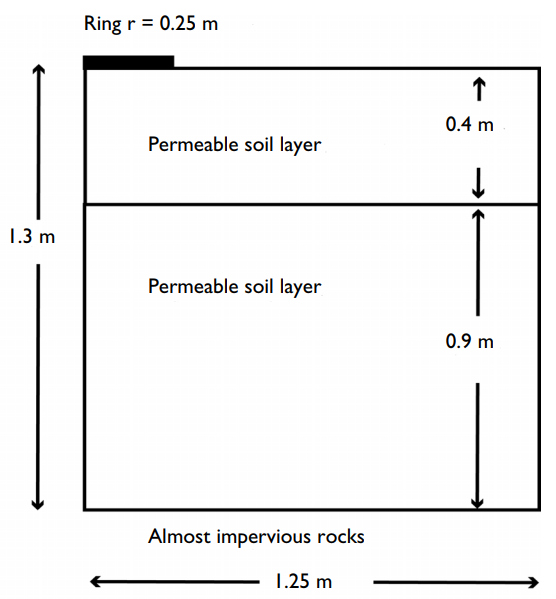
Figure 3. Axisymmetric model geometry representing infiltration beneath a surface source. Infinite element boundaries extend the domain beyond the modelled region to prevent artificial plume confinement and allow realistic representation of contaminant migration.
Hydraulic Controls on Contaminant Migration
Water infiltration generates strong vertical hydraulic gradients beneath the source location, driving advective transport of dissolved contaminants through the soil profile.
As pressure equilibrates laterally, plume spreading increases, expanding the spatial footprint of contamination.
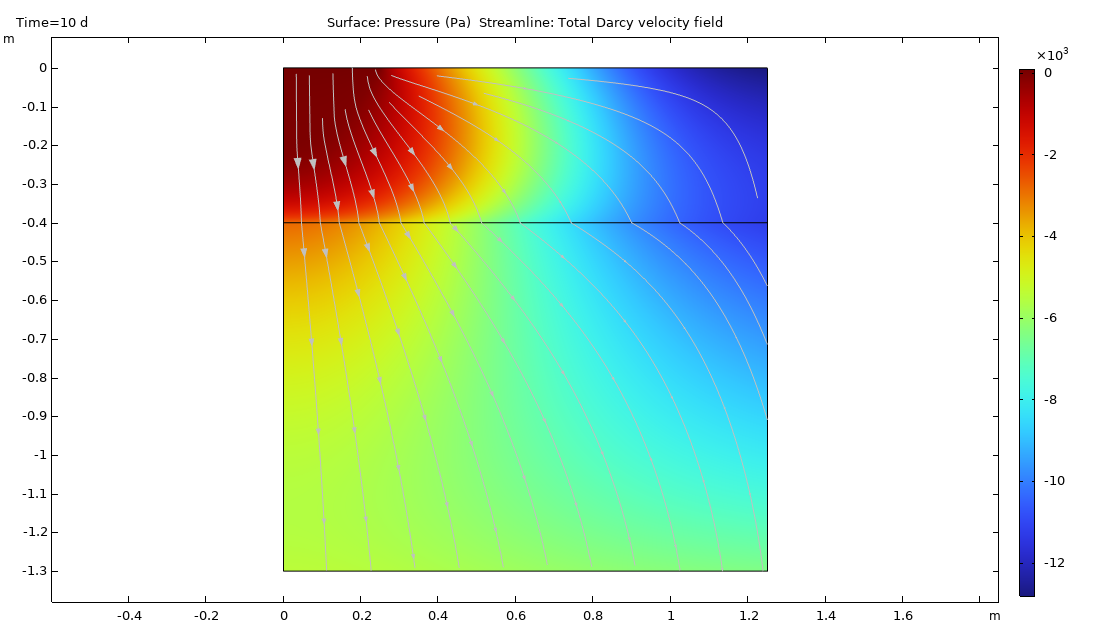
Figure 4. Pressure head distribution beneath the infiltration source. Vertical hydraulic gradients drive downward contaminant migration, while lateral pressure equilibration promotes radial plume expansion. Hydraulic structure therefore controls the depth and extent of subsurface contamination.
Species-Specific Transport Behaviour
Figure 5. Simulated distribution of the parent pesticide compound. Rapid degradation near the infiltration source limits long-distance transport of the original contaminant over 10 days.
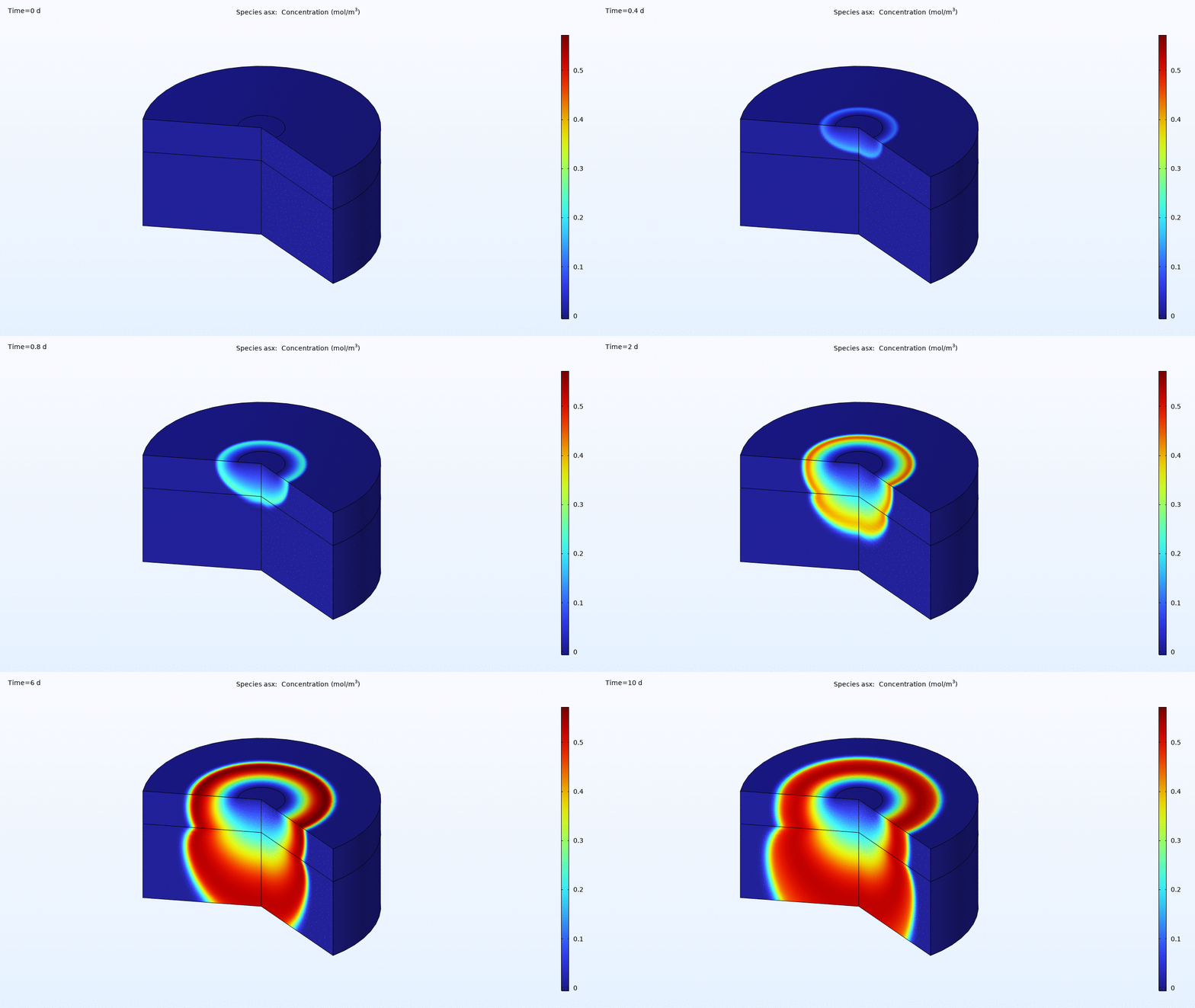
Figure 6. 10-day distribution of the sulfoxide degradation product. Greater mobility allows this intermediate species to spread over a larger soil volume than the parent compound, expanding the contamination footprint.
Figure 7. Distribution of the sulfone degradation product over 10 days. This secondary product persists at greater depths even as surface concentrations decline, increasing the potential for groundwater interaction during prolonged infiltration.
Model Assumptions
- Soil layers represented as homogeneous hydraulic media.
- Degradation reactions modelled using first-order kinetics.
- Constant infiltration rate imposed at the surface boundary.
- Sorption behaviour represented using equilibrium partitioning.
- Temperature and microbial activity assumed spatially uniform.
Model Limitations
- Field heterogeneity and preferential flow paths are not explicitly represented.
- Reaction rates are assumed constant and do not account for biological variability.
- Long-term climatic variability and episodic rainfall events are not simulated.
- Parameter uncertainty was not propagated through probabilistic analysis.
Key Insights
- Degradation does not necessarily reduce groundwater risk.
- Intermediate transformation products can be more mobile than the parent compound.
- Hydraulic gradients strongly control plume penetration depth.
- Coupled reaction–transport modelling is required for realistic risk assessment.
Note: This model builds on structured COMSOL training workflows and extends them to explore environmental transport behaviour and interpretation.