Terzaghi Consolidation Modelling for Aquifer Compaction and Subsidence Analysis
Finite element implementation of Terzaghi consolidation theory in COMSOL to simulate pore pressure dissipation and vertical compaction in layered aquifer systems under groundwater withdrawal.
Hydrogeological Modelling • Groundwater Mechanics • Aquifer Subsidence
Project Context
Groundwater extraction alters pressure conditions within aquifers, causing the sediment skeleton to bear additional stress and compact over time. This deformation process is a primary driver of land subsidence in groundwater-dependent regions.
This project implemented the classical Terzaghi one-dimensional consolidation theory within a finite element framework using COMSOL Multiphysics to simulate pore pressure dissipation and vertical compaction in layered sedimentary aquifers.
The objective was to visualise the interaction between groundwater flow, pressure decline, and aquifer deformation under sustained hydraulic stress.
Project Quick Facts
- Model Type
1D Terzaghi Consolidation - Simulation Platform
COMSOL Multiphysics - System
Layered Sedimentary Aquifer - Primary Process
Pore Pressure Dissipation - Outputs
Hydraulic Head, Velocity Field, Vertical Compaction - Application
Ground Subsidence Assessment
Analytical Framework
The modelling workflow simulated aquifer deformation caused by groundwater withdrawal using classical consolidation theory.
- Finite element simulation of groundwater flow
- Transient pore pressure dissipation
- Application of Terzaghi consolidation equations
- Post-processing calculation of vertical compaction
- Spatial interpretation of aquifer deformation patterns
The analysis combined hydrogeological theory with numerical modelling to visualise subsurface processes that are otherwise difficult to observe directly.
Model Physics
Aquifer compaction was evaluated using the classical Terzaghi consolidation framework, which links groundwater pressure decline to deformation of the sediment skeleton. The model couples groundwater flow with effective stress changes within compressible aquifer materials.
Hydrogeologic Processes Driving Land Subsidence
Swipe → to view full table
| Process | Governing Equation | Interpretation |
|---|---|---|
| Groundwater Flow |
q = −K ∇h
|
Darcy’s Law governs groundwater movement within the aquifer system. Groundwater pumping creates hydraulic gradients that drive pore pressure decline in surrounding sediments. |
| Pressure Dissipation |
∂h / ∂t = cv ∇²h
|
The consolidation equation describes transient dissipation of pore pressure through compressible sediments. The rate of pressure propagation depends on hydraulic diffusivity and permeability of the stratigraphic layers. |
| Sediment Compaction |
Δb = Ssk Δh
|
Vertical compaction occurs as pore pressure declines and effective stress increases. Settlement magnitude is proportional to skeletal specific storage and the magnitude of hydraulic head decline. |
Where: Δb = aquifer compaction; Ssk = skeletal specific storage; Δh = hydraulic head decline; q = Darcy flux; K = hydraulic conductivity; h = hydraulic head; cv = coefficient of consolidation.

Conceptual representation of the Terzaghi consolidation process illustrating how groundwater extraction increases effective stress within aquifer sediments. As pore pressure dissipates through drainage, the sediment skeleton progressively compacts, leading to measurable ground surface settlement.
Analytical Pipeline
Geometry Setup
Layered sedimentary system defined above impermeable bedrock
Hydraulic Simulation
Transient groundwater flow solved using Darcy’s Law
Pressure Evolution
Pore pressure decline driven by pumping boundary conditions
Compaction Analysis
Vertical deformation derived from skeletal specific storage
Model Geometry and Boundary Conditions
The simulation domain represents three sedimentary layers overlying an impermeable bedrock surface with a structural step.
Groundwater pumping from the lower aquifer generates hydraulic gradients that propagate through the sediment layers. These pressure changes drive the consolidation process.
- Layered sedimentary aquifer system
- Impermeable bedrock boundary
- Hydraulic head decline imposed at pumping location
- Transient groundwater flow simulation
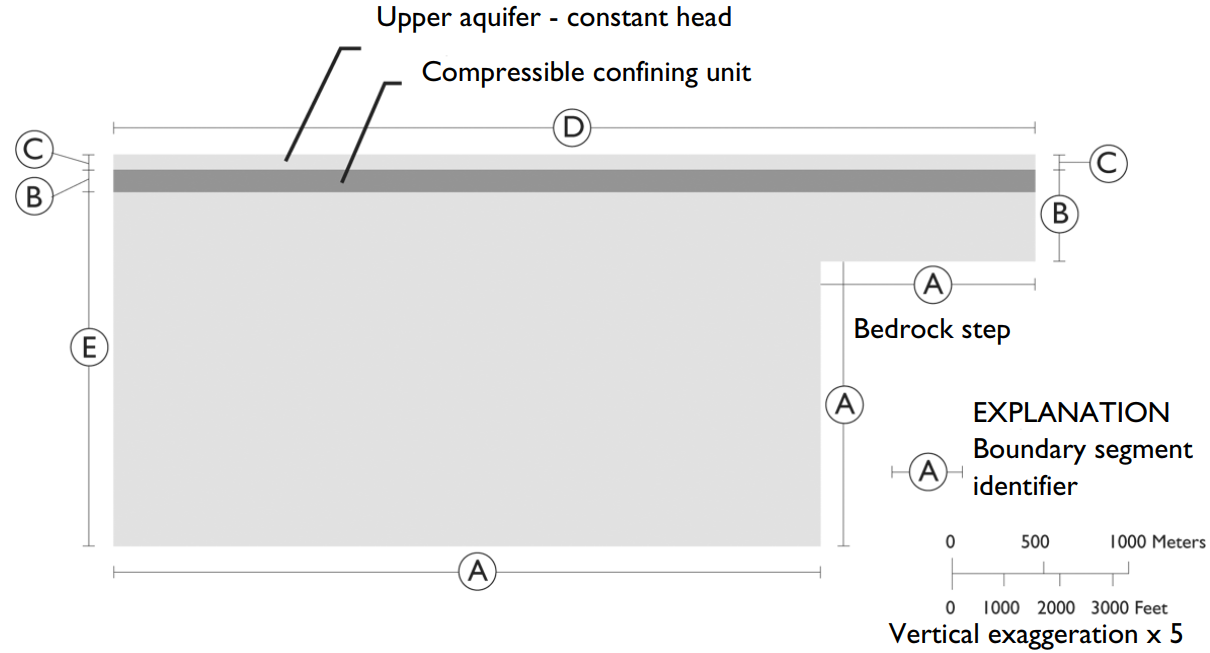
Finite element model geometry representing a layered sedimentary aquifer overlying an impermeable bedrock surface. Hydraulic head decline is imposed within the lower aquifer to simulate groundwater extraction, allowing analysis of pressure propagation and consolidation response within overlying sediments.
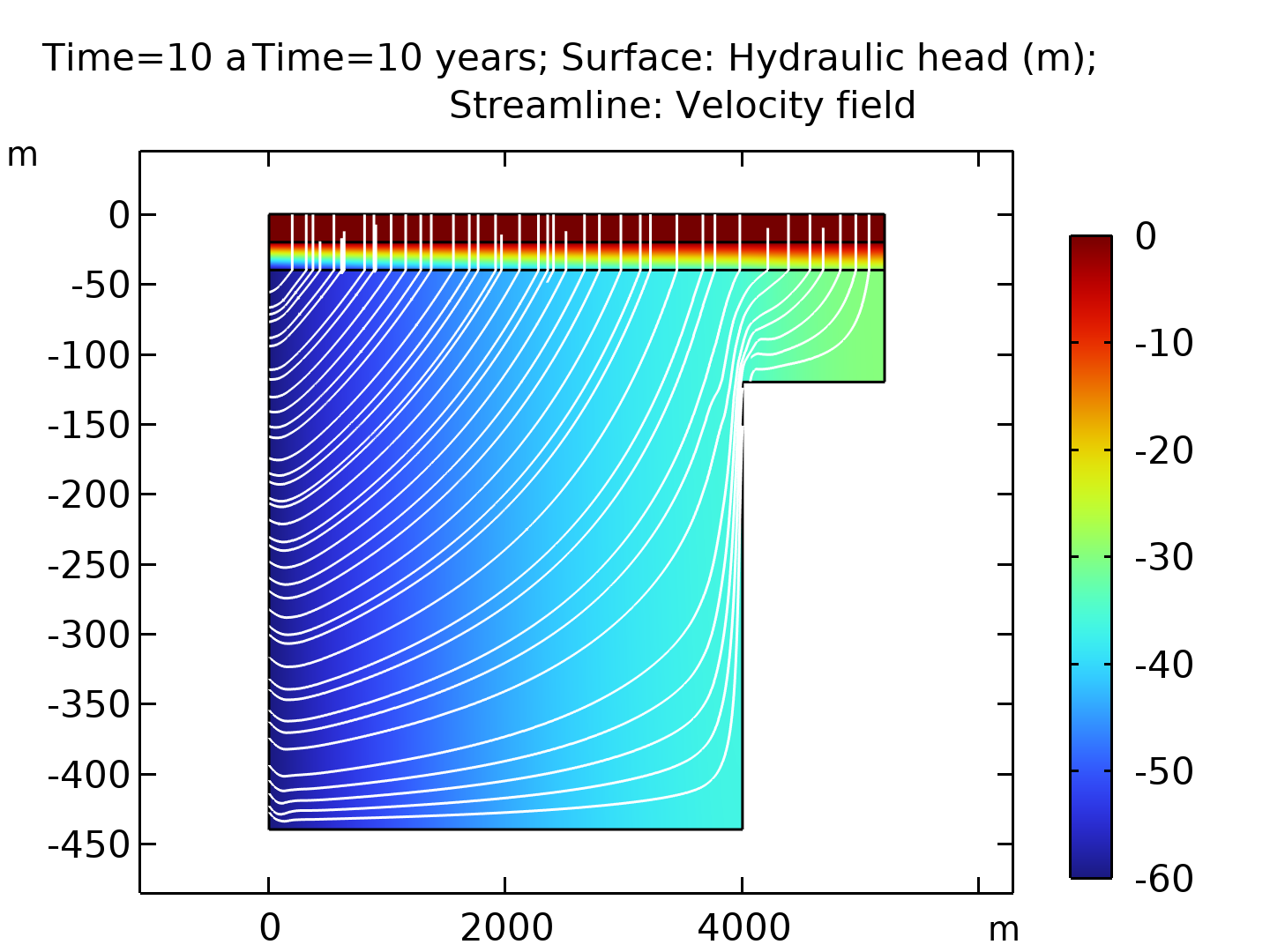
Hydraulic Head and Velocity Field
Groundwater flow converges toward the pumping boundary, creating spatial gradients in hydraulic head across the sedimentary layers.
Simulated hydraulic head distribution and groundwater velocity field generated by pumping from the lower aquifer. The resulting gradients drive pore pressure dissipation through overlying sediments, initiating the consolidation process that ultimately produces aquifer compaction.
Vertical Compaction Response
As pore pressure declines, the effective stress within the sediment skeleton increases, causing vertical compression of the aquifer layers.
The magnitude of compaction depends primarily on the skeletal specific storage and the magnitude of hydraulic head decline.
The simulation visualises the spatial distribution of vertical settlement within the aquifer system after a ten-year pumping period.
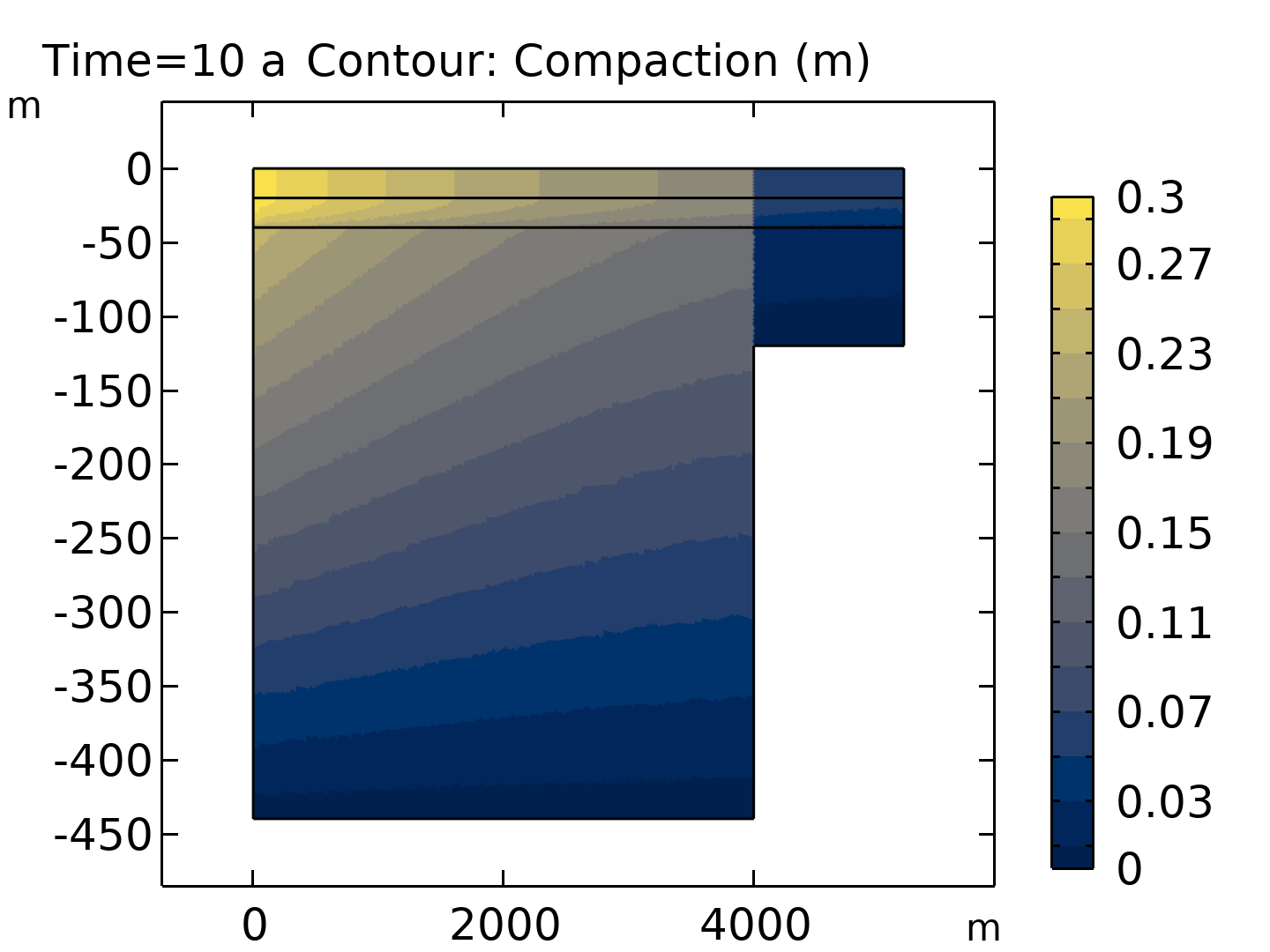
Simulated vertical compaction distribution after ten years of sustained groundwater extraction. Settlement magnitude varies across sediment layers according to hydraulic diffusivity and skeletal specific storage, illustrating how low-permeability strata delay pressure dissipation and concentrate deformation within compressible units.
Key Insights
- Pore pressure dissipation controls consolidation rate.
- Low-permeability layers delay settlement.
- Hydraulic stress redistributes load to the sediment skeleton.
- Subsidence processes evolve over long time scales.
Environmental and Infrastructure Relevance
- Ground subsidence risk assessment
- Groundwater extraction impact analysis
- Aquifer storage planning
- Infrastructure stability evaluation
Professional Relevance
This project demonstrates capability in:
- Hydrogeological numerical modelling
- Poroelastic process simulation
- Interpretation of aquifer deformation dynamics
- Integration with subsidence monitoring techniques (e.g. InSAR)
Note: This model builds on structured COMSOL training workflows and extends them to explore environmental transport behaviour and interpretation.