Environmental Intelligence • Decision Support • Remote Sensing
In the previous article, I asked what makes an environmental insight decision-ready.
The answer was not more data.
It was being able to explain where something matters, why it matters now, and what happens if nothing is done.
That last part is easy to overlook.
Because environmental intelligence has another dimension that is often treated as an afterthought: time.
A signal can be correct and still fail to create value if it is misunderstood, deprioritised, or acted on after the useful window for intervention has narrowed.
Getting It Wrong Doesn't Always Mean Getting the Data Wrong
When we talk about failure in environmental analysis, the first thing that usually comes to mind is an incorrect model, poor classification, bad data or an unreliable prediction.
Those failures matter.
But they are not the only ones.
An analysis can be technically sound and still fail in practice.
A signal can be identified but not prioritised.
An anomaly can be detected but not clearly interpreted.
A finding can be presented accurately but without explaining what it means for the decision in front of someone.
Or the significance can become clear only after the opportunity to respond has already narrowed.
The data can be right. The intelligence can still fail.
Delay Is a Form of Failure
The more I work with environmental data, the less I think of delay as simply a communication problem.
It is part of the analytical problem.
Environmental systems are constantly changing. Many changes accumulate gradually, often becoming significant only when viewed across longer periods or larger areas.
That is one reason satellite observation is so valuable.
It allows us to detect patterns before they become obvious through conventional observation alone.
But detecting something early is only useful if the information can move through the rest of the decision process while there is still time to respond.
Otherwise, the advantage of early detection begins to disappear.
The Decision Window
I have started thinking about this as a decision window.
There is often a period between the moment an environmental signal becomes meaningful and the point at which action becomes substantially more difficult.
That window is not the same for every problem.
For some environmental risks, it may be measured in hours or days.
For others, it may be months, years or even decades.
The principle is the same.
Information has practical value partly because of when it becomes understandable.
An observation that arrives after a decision has already been made may still be scientifically valuable.
But its value to that particular decision has changed.
Small Delays Can Become Large Consequences
This is where environmental problems become particularly difficult.
A wetland may lose vegetation gradually.
A watershed may experience increasing pressure from land-use change.
A river channel may shift incrementally.
None of these changes necessarily produces an immediate crisis.
But small changes accumulate.
And the longer they continue without an appropriate response, the more the available options may change.
Some interventions become more expensive.
Some become harder to implement.
Some ecological changes may become difficult to reverse.
This is why the cost of getting an environmental signal wrong is not always visible at the moment the analysis is produced.
Sometimes the cost appears later, in the options that are no longer available.
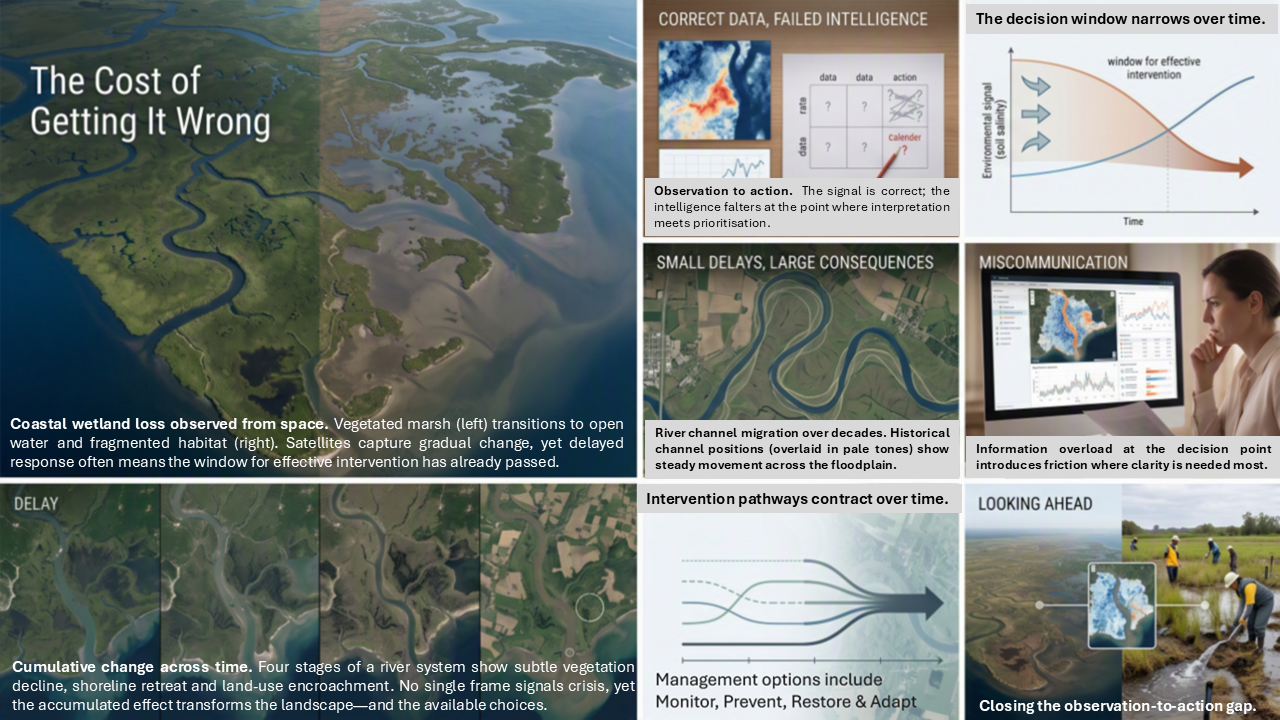
The observation-to-action gap: Environmental signals may be technically correct yet still fail to influence decisions when interpretation, prioritisation or timing introduces friction. These images document how delay accumulates, decision windows narrow, and available interventions contract—even when the underlying data remains sound.
Where Miscommunication Becomes Costly
There is a tendency to think that if the information exists somewhere, it can always be used later.
In theory, that makes sense.
In practice, decisions are made under constraints: limited attention, competing priorities, institutional processes, budgets and deadlines.
A technically correct output that requires substantial interpretation before it can be used introduces friction into that process.
One delay may not seem significant.
But when interpretation, communication and decision-making each add time, the gap between detection and response can become substantial.
This is not a hypothetical problem. Environmental decision-support research has long recognised that temporal reasoning, uncertainty and the way information moves through diagnosis and decision processes can influence the reliability of environmental decisions.
Rethinking What Failure Looks Like
Perhaps we need a broader definition of failure in environmental intelligence.
Failure can mean an incorrect analysis.
It can mean an important signal that was never recognised.
It can mean a correct finding that was framed in a way that made its significance difficult to understand.
And it can mean recognising the significance only after the useful decision window has narrowed.
These are different failures, but they have something in common.
The information did not successfully move from observation to meaningful action.
That is why better environmental intelligence is not simply about improving detection.
It is about reducing the distance between knowing and acting.
The Cost Is Often Hidden
The hardest part about measuring the cost of a missed environmental signal is that we rarely observe the alternative.
We can measure what happened.
It is much harder to measure what might have happened if the signal had been recognised earlier, interpreted differently, or acted upon in time.
That uncertainty should not make the problem disappear.
It should make us more deliberate about how environmental intelligence is designed.
If we know that timing affects the value of information, then timing should be considered when we decide what to monitor, how often to monitor it, how results are communicated, and who is responsible for acting on them.
Looking Ahead
The question I'm left with is not whether we can detect environmental change earlier.
In many cases, we already can.
The harder question is whether our systems are capable of recognising what matters, communicating it clearly, and responding while there is still something meaningful to change.
Because the value of an environmental signal is not only in whether it is correct.
It is also in whether we understand its significance in time to do something with it.
That raises the next question:
What happens when we stop talking about the problem in general terms and look at one simple case?