Environmental Intelligence • Decision Support • Remote Sensing
In the previous piece on the gap between geospatial insight and decision-making , I pointed out a recurring issue:
the bottleneck is rarely the data itself.
It is the translation of that data into something a decision-maker can use.
That raises a more practical question.
What does decision-ready actually look like?
When Technical Output Stops Short
Most satellite-derived outputs arrive in a familiar form:
- Classification maps
- Vegetation indices
- Change detection layers
- Time-series trends
They are technically sound. Often rigorous. Sometimes impressive.
But they stop at description.
They show what is happening.
They do not tell you what to do about it.
And for a decision-maker, that gap is everything.
The Real Question Decision-Makers Ask
In technical workflows, the implicit question is:
What does the data show?
In operational contexts, the question is different:
What does this mean for the decision I need to make?
That shift—from observation to implication—is where most outputs fall short.
A Simple Test for Decision-Readiness
In practice, decision-ready insight can be reduced to three questions:
- Where does this matter?
- Why does it matter now?
- What happens if no action is taken?
If an output does not answer these clearly,
it is not finished.
Not incorrect. Not useless.
Just not yet usable.
From Output to Action
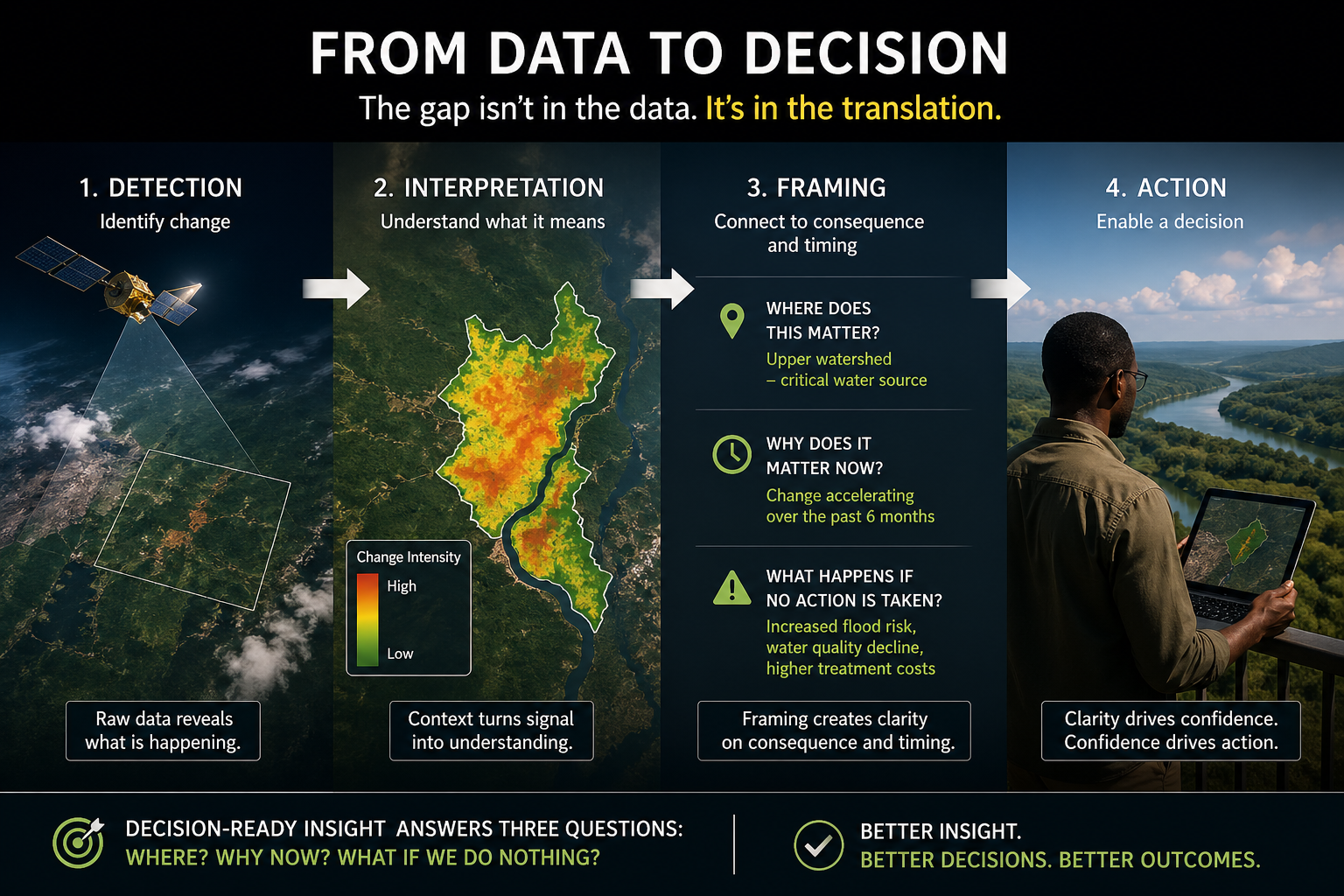
Turning data into decisions requires clear framing of consequence and timing.
Moving from detection to decision requires explicit framing of consequence and timing.
Detection → Interpretation → Framing → Action
The Difference Framing Makes
Consider a typical case:
An analysis detects a measurable land use shift or vegetation anomaly.
The output includes maps, statistics, and change metrics.
All valid.
But none of it drives action.
Now compare that with a reframed insight:
This area has undergone sustained change over the past six months. If the trend continues, it is likely to affect [specific outcome] within [timeframe]. There is still a window for intervention—but it is narrowing.
Same data.
Different outcome.
Why This Is Harder Than It Sounds
Technical teams are trained to prioritise completeness.
More layers. More metrics. More validation.
But decision-making does not reward completeness.
It rewards clarity.
Getting there requires deliberate choices:
- Which signal actually matters?
- What can be removed without losing meaning?
- What consequence is most relevant?
This is not simplification.
It is discipline.
Moving Beyond Description
Environmental intelligence becomes valuable at the point where it influences action.
That requires a shift:
Describing change
to
Framing consequence and timing
Because decisions are not made on data.
They are made on understanding.
The Work Is Not Finished Yet
If an output still requires interpretation before action,
it is not finished.
The technical work may be complete.
The analytical work is not.